What $400,000 Actually Buys in Great Valley vs. Ellicottville Village
August 27, 2026
August 27, 2026
In July 2026, homes listed for sale in Great Valley carried a median price of $417,000. Around the same time, the town's median sold price over the trailing twelve months was reported at $210,000, down 25 percent from a year earlier. Ellicottville tells a similar story from the other direction: a December 2025 sold median of $453,000, a trailing twelve-month median of $440,000, and a May 2026 listing median that had dropped to $299,000. Ask which number describes the market and the honest answer is none of them, exactly. They're all true. They're also all measuring something narrower than "the market."
If you're comparing Great Valley and Ellicottville because you've seen these numbers on a portal and you're trying to figure out which town is the better value, the numbers themselves are the wrong place to start. Here's why, and here's what to look at instead.
Both towns are small enough that a single closing can swing the reported median by tens of thousands of dollars. Great Valley recorded roughly 23 home sales over the trailing twelve months, with about 15 active listings at any given time. When your sample size is that small, "median" stops behaving like a thermometer that reads the temperature of the whole market and starts behaving more like a dice roll shaped by whatever happened to close that month.
Here's how the same two towns looked across different sources and windows this year:
| Town | Source & Window | Reported Median | Type |
|---|---|---|---|
| Ellicottville | Movoto, January 2026 | $397,000 | Sold |
| Ellicottville | Redfin, December 2025 | $453,000 (down 17.7% YoY) | Sold |
| Ellicottville | Homes.com, trailing 12 months (as of May 2026) | $440,000 (up 13% YoY) | Sold |
| Ellicottville | Movoto, May 2026 | $299,000 (down 33% YoY) | Listing |
| Great Valley | Movoto, July 2026 | $417,000 (down 9% YoY) | Listing |
| Great Valley | Homes.com, trailing 12 months | $210,000 (down 25% YoY) | Sold |
| Great Valley | Redfin, May 2026 | $199,631 (down 18.5% YoY) | Sold |
Notice two things happening at once. First, listing medians and sold medians aren't the same measurement, one reflects what sellers are asking, the other reflects what buyers actually paid, and in a slow-moving market those two numbers can drift apart. Second, even within "sold" figures, the window matters enormously. A single luxury chalet closing in one month and a single manufactured home closing the next can move a twelve-house town's median by six figures.
Neither town's market cooled by 20 to 25 percent in a single year in the way these headline figures suggest. What changed was the mix of what happened to sell.
The clearest way to see the mixing problem is to look at what actually closed in Great Valley recently. In one twelve-month stretch, recorded sales included a 1,060-square-foot farmhouse built in 1900 that sold 21 percent below its list price at roughly $66 per square foot after 174 days on the market, a 54.7-acre parcel of land that closed for $700,000, and a 19.6-acre parcel that closed for $175,000. Back in August 2025, a 3.92-acre lot sold for $130,000, a full 161 percent above its asking price. Meanwhile, current inventory in town includes a renovated one-bedroom ski-in, ski-out condo in Snowpine Village at Holiday Valley, the kind of unit that, whenever it does sell, will report as a "Great Valley" transaction even though it functions more like a slice of the resort itself.
Average a century-old farmhouse, a resort condo, and two raw land parcels together and you get a number. What you don't get is a description of any single property a buyer could actually walk through. This is the same reason a doctor's office reporting an "average patient age" of 45 might have no forty-five-year-olds on the books at all, just a mix of toddlers and retirees. The median in a market this size tells you almost nothing about what your specific budget will buy until you know which slice of inventory you're actually shopping in: land, a rural single-family home, a manufactured home, or a resort condo.
Ellicottville's swings work the same way, just with a different mix. The village's inventory spans manufactured homes and Cape Cods on one end to multi-level luxury townhomes and A-frame chalets near the resorts on the other, with prices ranging from roughly $45,000 to nearly $2.5 million across active listings. A month where a couple of high-end chalets close will pull the median sharply upward. A month dominated by starter homes and land will pull it back down. Days on market moved in the same uneven way, from 115 days in January 2026 to 114 days in May, generally slower than the national norm of around 58 days, which tells you more about a patient, less competitive market than either median price does on its own.
Set the medians aside and think in terms of property type instead.
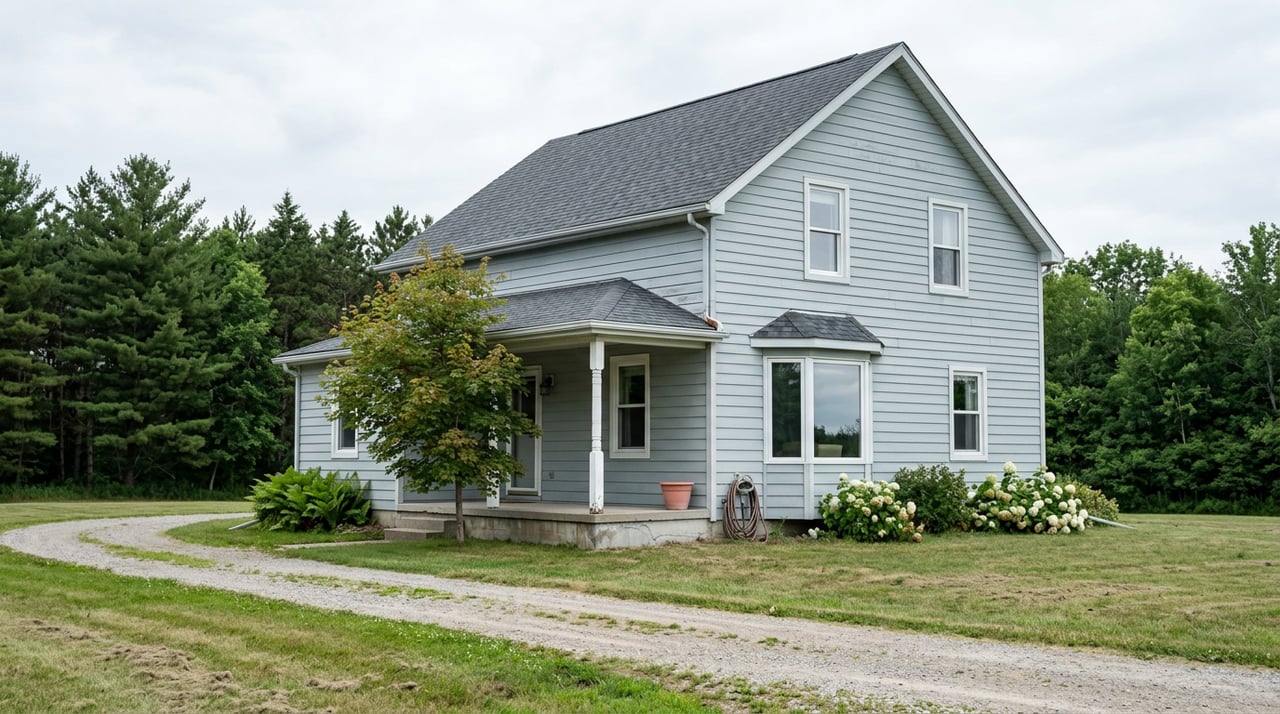
At the lower end, Great Valley has older farmhouses on the outskirts of town, the kind that sell well below list when they need work, and manufactured or single-wide homes positioned within a short drive of the slopes. In the low-to-mid $300,000s, buyers are typically looking at conventional three-bedroom homes on a double lot, sometimes with a carport, deck, or storage shed, the kind of practical rural inventory that doesn't show up in glossy listing photos but covers most of what year-round residents actually live in.
Land is a category of its own here, and it moves independently of the housing stock entirely. Wooded acreage near McCarty Hill and Rock City State Forests, or parcels close to Red House Lake and Spruce Lake, can range from under $10,000 an acre to well over $30,000 an acre depending on clearing, road frontage, and proximity to the village. If you're comparing "Great Valley" to "Ellicottville" as a single number, land sales like these are quietly doing a lot of the pulling.
And then there's the resort layer: units like the Snowpine Village condo mentioned above put a buyer in true ski-in, ski-out territory without a village-core price tag, a fundamentally different purchase than a farmhouse a few miles away, even though both fall under the same town name on a portal search.
For daily life, Great Valley's center of gravity is quieter than the village. Katy's Fly-In Restaurant, known for its aviation-themed decor, and Clark's Market and Deli cover the everyday errands. Pumpkinville, open daily from September 13 through October 31 this season, and the Great Valley Volunteer Fire Co.'s annual Band Jam fundraiser at the Firemen's Clubhouse on Depot Street give the town its own calendar, separate from the village's tourist season.
Move a few minutes down the road and the same budget buys proximity instead of acreage.
In the heart of the village, buyers pay for walkability: Katy's Café, The Gin Mill, and Ellicottville Brewing Co. within blocks, TOPS Friendly Market for groceries, Ellicottville Village Park with its playground and courts, Elmer's Dog Park, and the Nannen Arboretum's trail and gardens all inside a compact footprint built around foot traffic rather than driveways. That density is exactly why the village's housing stock looks so different from Great Valley's. Where Great Valley trades in farmhouses and open acreage, the village center is a mix of Colonial Revivals, Cape Cods, and manufactured homes, with condos, townhouses, and A-frame chalets clustered closer to Holiday Valley and HoliMont.
Townhouses currently list between roughly $182,000 and $699,900, a wide enough range that "median" collapses two very different buyer profiles, the studio unit across from the slopes and the multi-level luxury townhome with a private primary suite, into one figure. The same is true at the top end of the market, where a handful of high-value chalet or estate sales in any given month can carry the whole village's median upward even if most of what actually traded that month was modest.
The practical takeaway: a buyer who wants to walk to dinner and skip a car trip for most errands is paying, in part, for that convenience, and the village's price range reflects a market with more resort-adjacent inventory competing for the same limited land.
Instead of asking which town's median is lower, ask three narrower questions that the median can't answer for you:
Does a lower reported median mean Great Valley is cheaper than Ellicottville? Not reliably. Great Valley's lower medians reflect a mix that includes farmhouses needing work and raw land, categories that pull the number down regardless of what a comparable single-family home actually costs there. Compare like properties, not town-wide averages.
Why do days-on-market numbers matter more than they seem to? In a market this small, a property sitting for 150 or 200 days usually signals pricing or condition issues specific to that listing, not a town-wide slowdown. It's one of the more reliable local signals precisely because it isn't as easily distorted by a single big sale the way median price is.
Should I trust listing prices or sold prices when comparing towns? Sold prices reflect what buyers actually paid and are the better signal, but they lag listing prices by weeks or months, especially in a market where homes sit for 100-plus days. Use listing prices to gauge current seller expectations and sold prices to gauge what will actually be accepted.
Comparing these two towns well means comparing categories of property, not town names. If you want help sorting out what a specific budget actually buys, in Great Valley's rural inventory, in the village center, or somewhere in between, Jennifer Courtney can walk through the current inventory with you property type by property type. Let's Connect.
Stay up to date on the latest real estate trends.
Whether you're buying your first home, searching for a second home in the mountains, investing in Ellicottville real estate, or preparing to sell, Jennifer Courtney is here to make the process feel clear and manageable. With a thoughtful, personal approach and a deep appreciation for the local market, she takes the time to understand what you're looking for and provides guidance tailored to your goals. From the initial conversation through closing, you'll have an experienced advocate who is ready to listen, communicate, and help you move forward with confidence.
(716) 998-1126
[email protected]
3400 SOUTHWESTERN BLVD
ORCHARD PARK, NY 14127