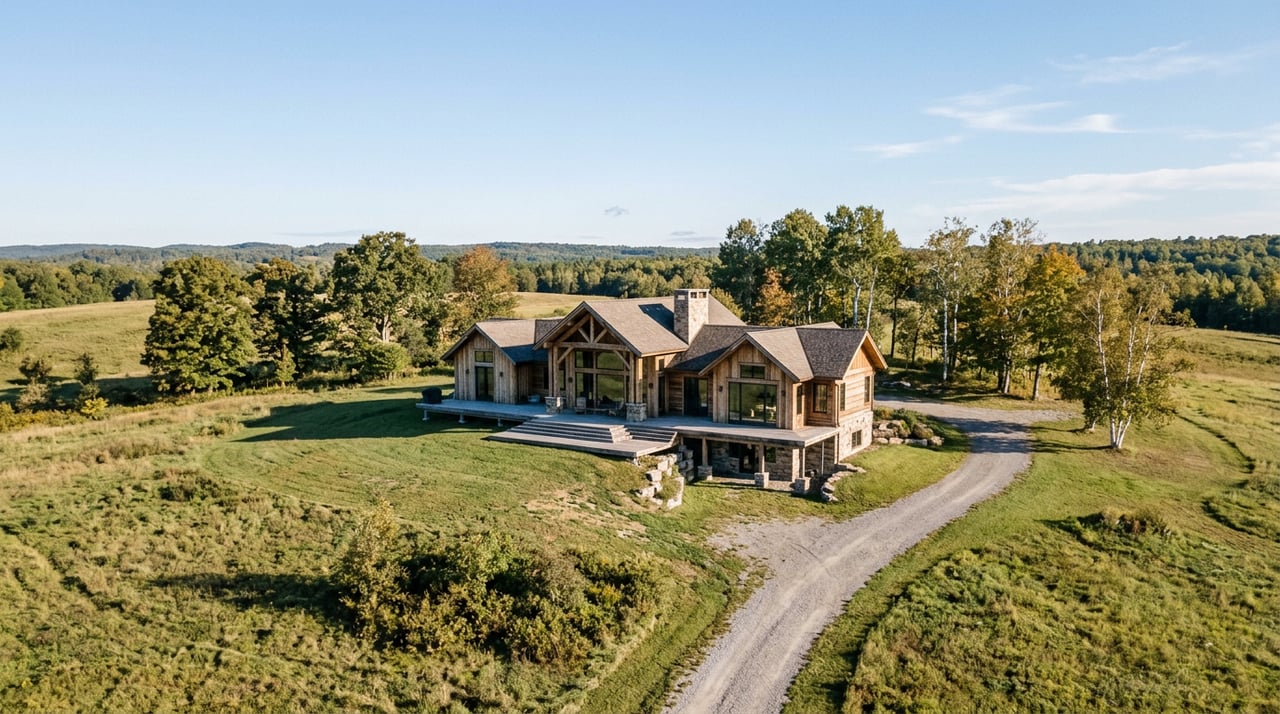
Why an Agricultural Disclosure Shows Up on Almost Every Deed in Great Valley
September 3, 2026
September 3, 2026
Why does a rural land contract in Great Valley include a paragraph about noise, dust, and manure smells when there's no working farm anywhere near the property line?
That question comes up often enough that it's worth answering properly, because the answer explains more than one line item on a closing document. It explains why a piece of land ten minutes from Ellicottville village runs on a well and a septic tank instead of municipal lines, and it explains why that isn't bad luck or an oversight. It's the predictable result of a single state law that shapes almost everything else about buying land in this town.
New York requires a specific disclosure whenever a property sits partially or wholly inside a state-certified agricultural district. Under Real Property Law section 333-c, the seller has to hand the buyer a signed notice stating that farming activities occur in the district and that those activities, including noise, dust, and odor, are a normal and expected part of living there. Both parties sign it before the sale closes.
Most buyers assume this only applies if there's an active farm visible from the driveway. In Great Valley, that assumption doesn't hold, because the disclosure isn't triggered by what's next door. It's triggered by geography. The entire town sits inside Cattaraugus County's Agricultural District #5, a single certified district that has covered every municipality in the county since it was created on July 10, 1977. There's no smaller district, no parcel-by-parcel exception. If the land is in Great Valley, it's almost certainly in the district, whether the nearest neighbor grows anything or not.
That's the first thing worth understanding before you go looking for a lot "away from the farms." In Great Valley, that search doesn't really work the way it would somewhere with patchwork zoning. The farmland designation is countywide by design.
It also isn't a formality left over from a different era. Great Valley has working agricultural land right now. Lindell Farm operates on Klawitter Road, and Schultz Farm grows sweet corn, pumpkins, gourds, and hay within the town. These aren't relics the disclosure gestures at from a distance. They're active operations, and the law exists in part because of them.
Cattaraugus County backed that protection further in 1995, when the county legislature passed its own right-to-farm local law, giving farmers and farmland owners added standing against nuisance complaints and disputes tied to normal agricultural operations. Between the state district designation and the county's own law, the message to anyone buying land here is consistent: agriculture isn't an inconvenience the town tolerates. It's a use the law is built to preserve.
None of this changes what you're allowed to do with your own land. An agricultural district isn't a zoning designation, and it doesn't restrict a landowner's ability to build a home, develop a lot, or later sell it for residential use. What it does is put buyers on formal notice that farming, and the sounds and smells that come with it, are part of the deal.
Here's the part that connects the disclosure to something buyers usually treat as unrelated. The state Agricultural Districts Law doesn't just protect farms from nuisance complaints. It also limits how public money can be spent on infrastructure inside a certified district, including the extension of municipal sewer and water lines. The law is written to slow exactly the kind of development pressure that would eventually push farmland out.
Practically, that means fewer publicly funded utility extensions ever reach the interior of a district like Great Valley's. Fewer extensions means more properties stay on the systems they've always had: a private well and a septic tank. This isn't a coincidence of rural life in general. It's a direct, if quiet, consequence of the same law that put the farm disclosure in your contract.
Cattaraugus County has its own separate response to all those private systems. Most real property transfers involving an onsite well or septic setup require a water and wastewater survey through the county's Environmental Health Division before the sale can close. A well inspection includes a bacteriological water sample and a physical check of the source and equipment. A septic inspection typically means a dye test, where dye is introduced through the toilet and water is run through faucets for up to an hour to confirm the system is working the way it should.
This survey exists independently of anything your lender might require. Lenders often order their own well and septic inspections as part of underwriting, but that doesn't satisfy the county's requirement, and the county's requirement doesn't satisfy the lender's. Buyers who assume one covers the other sometimes find that out later than they'd like.
For a typical land or rural home purchase in Great Valley, expect three separate pieces of paperwork moving in parallel rather than one after another:
None of these should be treated as a red flag when they show up. The county's disclosure form is explicit that failing to provide it doesn't stop a deed from being recorded. It's a required practice, not evidence of a defect, and skipping it isn't in anyone's interest since it's the thing that puts everyone on record about what the buyer knew going in.
Step back from the individual forms and a clearer picture appears. Great Valley isn't harder to buy into because it's disorganized. It's harder to buy into casually because the county has spent decades building legal structure around keeping it agricultural: one certified district covering the whole town since 1977, a local right-to-farm law since 1995, and funding limits that quietly steer municipal infrastructure elsewhere.
For a buyer who actually wants privacy, acreage, and a landscape shaped by working farms rather than subdivisions, that structure is the point, not the obstacle. It's the reason land near Lindell Farm or Schultz Farm still looks and functions the way it does. The paperwork is simply how that protection shows up on your closing table.
Does being inside an agricultural district affect my ability to get a mortgage or build on the land? No. The district designation is separate from zoning and from the state's Agricultural Assessment Program. It doesn't restrict use or classification of the parcel itself.
If the property already has a well and septic system in place, do I still need the county survey? In most cases, yes. Exemptions exist for properties connected to both public water and sewer, transfers through foreclosure, transfers between immediate family members for an owner-occupied home, and transfers by operation of law such as inheritance. Rental properties are not exempt even within a family transfer.
What happens if the seller forgets to provide the agricultural disclosure? The deed can still be recorded, but it's a required disclosure under state law, and completing it protects both sides by putting the buyer's awareness of nearby farming activity in writing.
If you're weighing land in Great Valley against a village lot in Ellicottville, or trying to figure out what a specific parcel's well, septic, and ag-district status actually means for your timeline, that's exactly the kind of groundwork worth walking through before you write an offer. Jennifer Courtney works these details for a living. Let's Connect.
Stay up to date on the latest real estate trends.
Whether you're buying your first home, searching for a second home in the mountains, investing in Ellicottville real estate, or preparing to sell, Jennifer Courtney is here to make the process feel clear and manageable. With a thoughtful, personal approach and a deep appreciation for the local market, she takes the time to understand what you're looking for and provides guidance tailored to your goals. From the initial conversation through closing, you'll have an experienced advocate who is ready to listen, communicate, and help you move forward with confidence.
(716) 998-1126
[email protected]
3400 SOUTHWESTERN BLVD
ORCHARD PARK, NY 14127